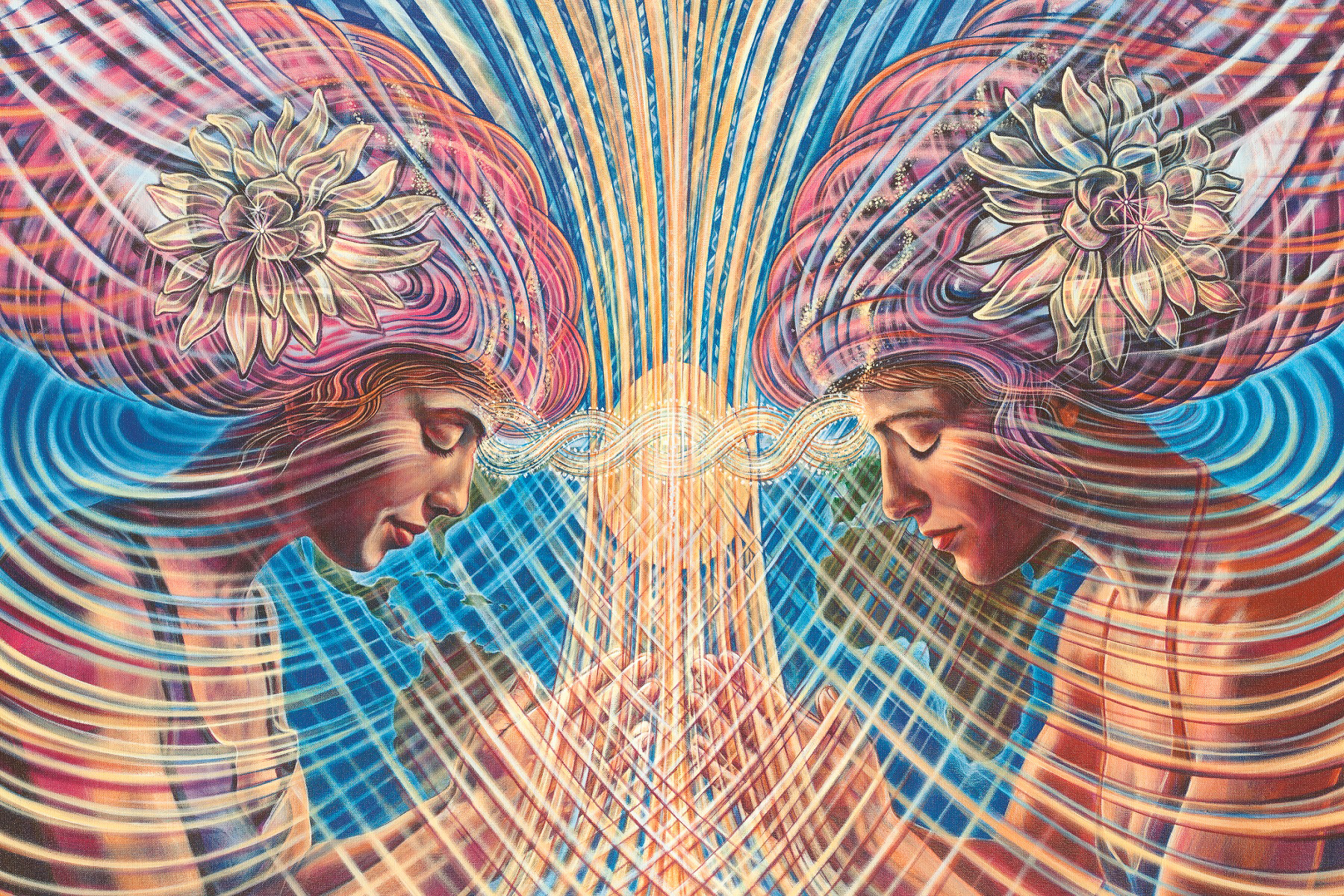
1. What is a spiritual awakening?
Answer
A spiritual awakening is a fundamental change in the way we experience ourselves and reality. Instead of being completely identified with our thoughts, emotions, personality and physical life, we begin to recognise that there may be a deeper level of consciousness behind them.
For some people this change develops gradually through meditation and inner exploration. For others it can occur unexpectedly and may be accompanied by a powerful sense of stillness, unity, expanded awareness or a profound shift in perspective.
The important point is that awakening is more than adopting a new belief. It is an experiential change. Something that was previously understood only intellectually begins to be recognised directly.
Awakening can therefore mark the beginning of a much deeper investigation into consciousness and into the question of what we really are.
2. What is the difference between awakening and enlightenment?
Answer
The words awakening and enlightenment are sometimes used as though they mean the same thing, but it can be helpful to distinguish between them.
Awakening may be understood as the first profound recognition that we are not simply the ordinary thinking mind and personality. The familiar sense of being a separate individual can begin to loosen, revealing a much wider field of consciousness.
Enlightenment represents a much more complete transformation. What may initially have appeared only briefly during awakening becomes established as the fundamental way in which reality is experienced.
From this perspective, awakening is not necessarily the end of the journey. It may instead be the opening of a door through which a much deeper development of consciousness becomes possible.
3. What happens to the sense of self during awakening?
Answer
In ordinary life we normally experience ourselves as a distinct individual located somewhere within the body, looking out at a world that appears separate from us.
During awakening this familiar structure can begin to change. The sense of being a separate centre may weaken, and awareness can seem much more spacious than the personality through which we normally experience life.
Thoughts, memories and emotions do not necessarily disappear. What changes is our relationship with them. They may increasingly be recognised as events arising within consciousness rather than as the essence of who we are.
This can produce a remarkable shift in identity. Instead of experiencing consciousness as something possessed by the individual, the individual may begin to seem like something appearing within consciousness.
4. Can spiritual awakening happen suddenly?
Answer
Yes. Although awakening may develop gradually over many years of meditation or spiritual practice, profound changes in consciousness can also occur very suddenly.
A person may experience an unexpected moment in which ordinary thought becomes completely still, the normal sense of separation disappears, or reality is perceived with extraordinary clarity and immediacy.
Such an experience can last seconds, minutes or considerably longer. Its importance does not necessarily depend upon its duration. Even a brief opening can permanently change someone’s understanding of consciousness and of themselves.
However, a powerful awakening experience should not automatically be confused with permanent enlightenment. The experience may reveal what is possible while further development is still required before that state becomes fully established.
5. Why can spiritual awakening sometimes be confusing?
Answer
Awakening can challenge some of the most fundamental assumptions we have made about ourselves throughout our lives.
We are accustomed to thinking of ourselves as a particular personality with a history, ambitions, fears, relationships and opinions. If that identity suddenly appears much less substantial than we previously believed, the experience can be both liberating and disorientating.
There may also be experiences for which a person has no familiar language: profound stillness, inner Light and Sound, expanded awareness or a temporary disappearance of the usual sense of self.
For this reason, awakening is not always accompanied simply by bliss. Understanding and integrating what has happened can take time. The deeper process involves learning to live ordinary life while recognising a reality that may extend far beyond our previous understanding of ourselves.
6. What is enlightenment?
Answer
Enlightenment is traditionally regarded as one of the highest possibilities of human consciousness. Different spiritual traditions describe it in different ways, but they commonly point towards a profound transformation in our sense of identity.
The ordinary individual normally experiences itself as the centre of consciousness: a separate person observing and responding to the world. In enlightenment this deeply rooted sense of separation may fall away.
What remains is not unconsciousness or emptiness in the ordinary sense. On the contrary, awareness may be experienced with extraordinary clarity, but without the same psychological centre claiming experience as “mine”.
Enlightenment is therefore not simply knowing more, becoming unusually intelligent or adopting spiritual beliefs. It concerns a fundamental change in the structure of consciousness itself and in the understanding of what we are.
7. Does an enlightened person still have thoughts and emotions?
Answer
Enlightenment does not necessarily mean that thought, emotion or personality disappear. An enlightened person still needs to communicate, remember, make decisions and respond to the practical demands of everyday life.
The difference lies in identification. Thoughts may continue to arise, but they are no longer necessarily experienced as defining a separate inner self.
Emotions may also occur naturally. Compassion, affection, sadness, humour and even irritation can still be part of human life. What may be greatly reduced is the psychological attachment that turns passing thoughts and emotions into a continuing personal drama.
The personality therefore remains available as an instrument for living in the world, while consciousness is no longer confined to the belief that the personality is what we fundamentally are.
8. What happens to the sense of “I” in enlightenment?
Answer
For most people the word “I” seems to refer to an inner centre: the person who is thinking the thoughts, making the decisions and experiencing the world.
Deep meditation can reveal that this centre is much less solid than it appears. Thoughts arise, perceptions occur and awareness remains, even when the usual sense of an internal observer becomes very quiet.
In enlightenment, according to many contemplative descriptions, this change becomes fundamental. The practical use of the word “I” continues, but the feeling of being a separate psychological entity at the centre of consciousness may no longer dominate experience.
There is still a functioning human being, but the boundary between “me” and the rest of existence may no longer be experienced in the same absolute way.
9. Is enlightenment the end of spiritual development?
Answer
Enlightenment is often described as the culmination of the spiritual journey, but that does not necessarily mean that every form of development simply stops.
A fundamental transformation in consciousness can take place while the individual continues to live, learn, communicate and respond to new circumstances.
There may also be deeper dimensions of consciousness beyond those normally accessible to human awareness. Experiences of inner Light and Sound and increasingly profound states of meditation suggest that consciousness may possess levels and possibilities that are difficult to place within a simple beginning-and-end model.
It may therefore be better to regard enlightenment not merely as reaching the end of a path, but as a profound transition in which the nature of the journey itself changes.
10. How can we know whether awakening or enlightenment is genuine?
Answer
This is an important question because unusual experiences, powerful emotions and altered states of consciousness can easily be interpreted as spiritual attainment.
A genuine awakening should involve more than excitement, visions or an intellectual conviction that something extraordinary has happened. The deeper question is whether there has been a lasting change in consciousness and in the individual’s relationship with thought, identity and the sense of separation.
With enlightenment the change would be expected to be still more fundamental and stable. It is not simply a temporary experience that comes and goes, but a transformation in the underlying way reality and the self are experienced.
Ultimately, spiritual development is best approached through careful observation and direct experience rather than through claims or titles. What matters is not what someone calls themselves, but what has actually changed within consciousness.