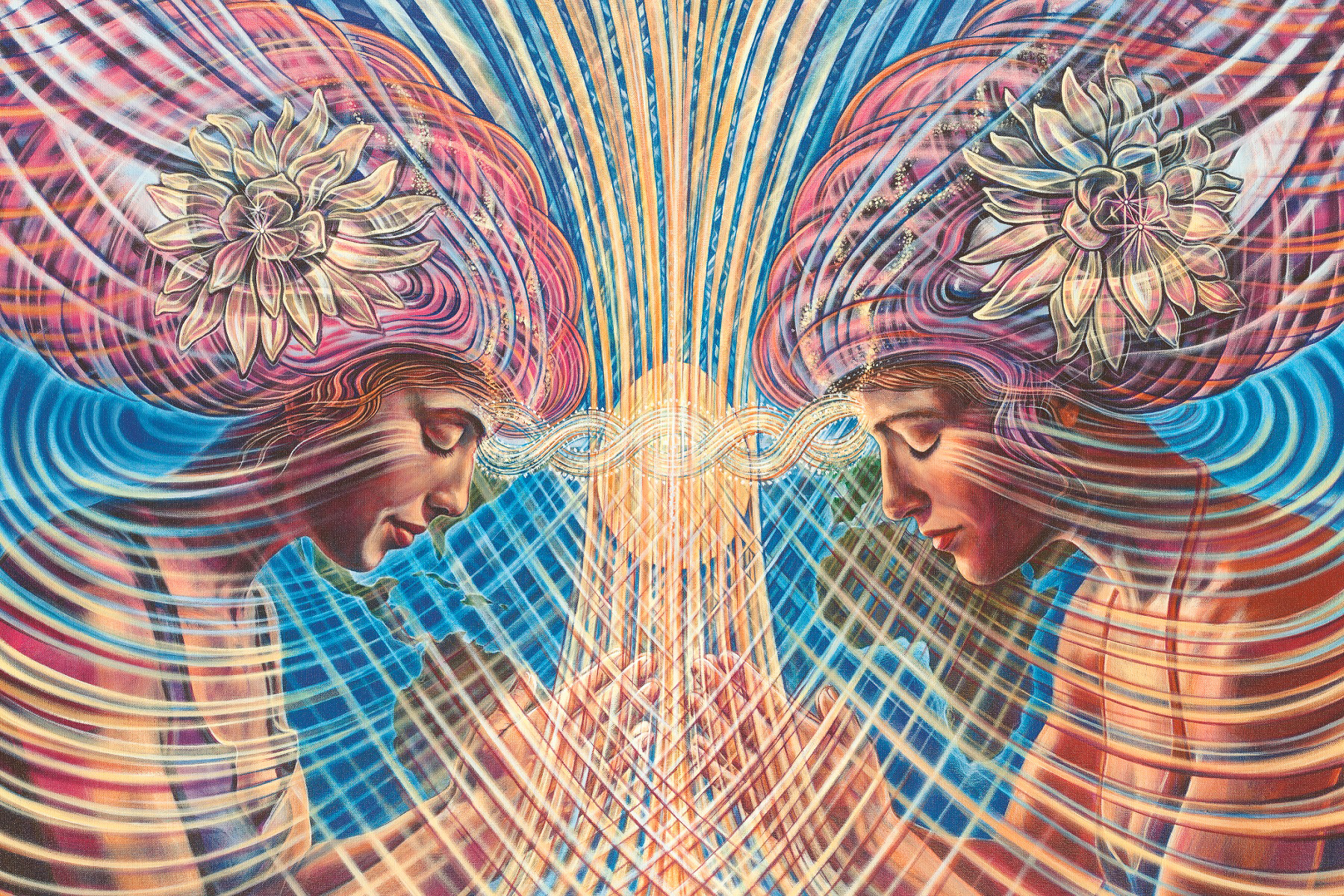
Enlightenment has been described in many different ways across spiritual traditions, philosophies and individual accounts. Some understand it as liberation, self-realisation, union with the Divine or the direct recognition of pure consciousness. Within this website, Enlightenment is understood as a fundamental transformation in which identification with the separate inner self comes to an end and the unity of all existence is directly realised.
Awakening experiences may reveal this deeper reality for a time. Enlightenment is not simply a temporary state, vision or feeling, but a more complete change in the centre from which life is experienced.
Beyond the Separate Self
Most people experience life from an inner centre that appears to say, “I am here, and the world is outside me.”
Thoughts, feelings, memories and experiences are gathered around this sense of being a separate individual. Even profound spiritual experiences may initially be interpreted by the mind as something that happened to “me.”
In Enlightenment, this central identification is understood to dissolve.
The practical human personality remains. The person can still think, speak, make decisions, remember the past and respond to everyday responsibilities. What ends is the deeper conviction that there is a separate inner entity controlling or possessing life.
There may no longer be the same sense of standing apart from existence. Life continues, but it is experienced as a movement within one undivided consciousness.
All Is One
The statement “All is One” can sound like a spiritual belief or philosophical idea. In Enlightenment, it may become a direct reality rather than a concept.
The boundaries through which life was previously divided into self and other, inner and outer, sacred and ordinary may fall away.
This does not mean that physical distinctions disappear. One person remains visibly different from another, and the practical world continues to function through difference and form.
Yet beneath these differences, there may be the unmistakable recognition that everything arises within the same consciousness and has never truly been separate from it.
A deeper view suggests that unity is not something created by Enlightenment. It is what has always existed, but was previously obscured by identification with the individual self.

Experiences Around Enlightenment
The movement towards Enlightenment may be accompanied by powerful experiences.
There may be brilliant inner Light, vast spaces, starry skies, radiant forms, intricate geometries or movement through different planes of consciousness.
Inner Sound may become clearer and more powerful. A person may experience music, fine high frequencies, bells, rushing currents, vibration or a great spiritual Sound that appears to draw awareness beyond the mind.
There may also be profound peace, bliss, love, freedom, timelessness or a temporary disappearance of the body and ordinary identity.
Some experience a rapid movement, as though awareness is being carried at immense speed through levels of consciousness. Others enter a stillness so complete that movement, time and thought appear to cease.
These experiences can be deeply significant, but they are not necessarily Enlightenment in themselves. Experiences arise, remain for a time and pass. Enlightenment concerns the more fundamental ending of identification with the one who appears to possess the experience.
What Remains
Enlightenment does not remove the human being from ordinary life.
The body still requires food, rest and care. Emotions may arise. Practical difficulties still need to be addressed. Skills, preferences and individual characteristics may remain.
What changes is the relationship with these things.
Thoughts may arise without creating the same sense of a thinker at their centre. Emotions may move through awareness without becoming a permanent identity. Action may occur naturally in response to the needs of the moment.
The person does not necessarily become perfect, all-knowing or incapable of making practical mistakes. Enlightenment should not be confused with supernatural infallibility.
Rather, there may be a profound inner freedom because the separate self is no longer experienced as the absolute centre of existence.
Awakening and Enlightenment
Awakening can open awareness beyond the ordinary mind and reveal states of unity, Light, Sound, peace or expanded consciousness.
These openings may transform a person’s understanding of life. However, when the experience passes, the familiar sense of self may return.
Enlightenment may be understood as the completion of this deeper movement.
The distinction is not always simple. Awakening may unfold in stages, and the boundary between temporary revelation and permanent transformation may not immediately be clear.
For this reason, it is wise not to hurry to claim Enlightenment because of a powerful spiritual experience. Time, honesty and continuing observation reveal whether the separate centre has truly dissolved or whether it has simply become quieter for a while.
The value lies not in adopting a spiritual title, but in the freedom, clarity, compassion and absence of separation expressed through everyday life.

Living After Enlightenment
Life after Enlightenment may appear outwardly ordinary.
The person may continue working, caring for others, forming relationships and participating in the practical world. Yet inwardly, experience may no longer be organised around a separate self seeking security, status or completion.
Compassion may arise naturally because others are no longer felt to be fundamentally separate.
There may also be a deep acceptance of life as it unfolds, without the same inner resistance that once came from the demand that reality should conform to personal expectations.
This does not require passivity. Action can still be strong, intelligent and decisive. Injustice may still be challenged, difficulties addressed and boundaries maintained.
The difference is that action may arise from clarity rather than from the defensive needs of a separate identity.
Continuing Experience
Enlightenment does not necessarily bring an end to meditation or spiritual experience.
Inner Light and Sound may continue. Awareness may explore increasingly subtle levels of consciousness. There may be further revelation, deepening and understanding.
However, these experiences are no longer required to establish identity or prove spiritual attainment.
Meditation may become a natural resting within consciousness rather than a search for something absent.
The journey continues, but without the same sense of an individual traveller trying to reach a distant destination. What was being sought is recognised as the consciousness within which the seeking itself arose.
The Guidance page explores meditation, integration and the ways a person may respond to awakening experiences and continue more deeply.
In Essence
● Enlightenment is more than a temporary spiritual experience or expanded state.
● It may be understood as the ending of identification with the separate inner self.
● The practical personality remains, but it is no longer experienced as the absolute centre of life.
● Light, Sound, bliss, unity and expanded awareness may accompany the journey but do not alone define Enlightenment.
● “All is One” becomes a direct realisation rather than simply a belief.
● Life continues through the human form, but with greater freedom from separation and self-centred identification.
Enlightenment cannot be fully contained within words. Language can point towards unity, freedom and the dissolution of the separate centre, but the reality must ultimately be known directly. What remains is not a new spiritual identity, but life itself — undivided, immediate and whole.
Click for the next page: Children
