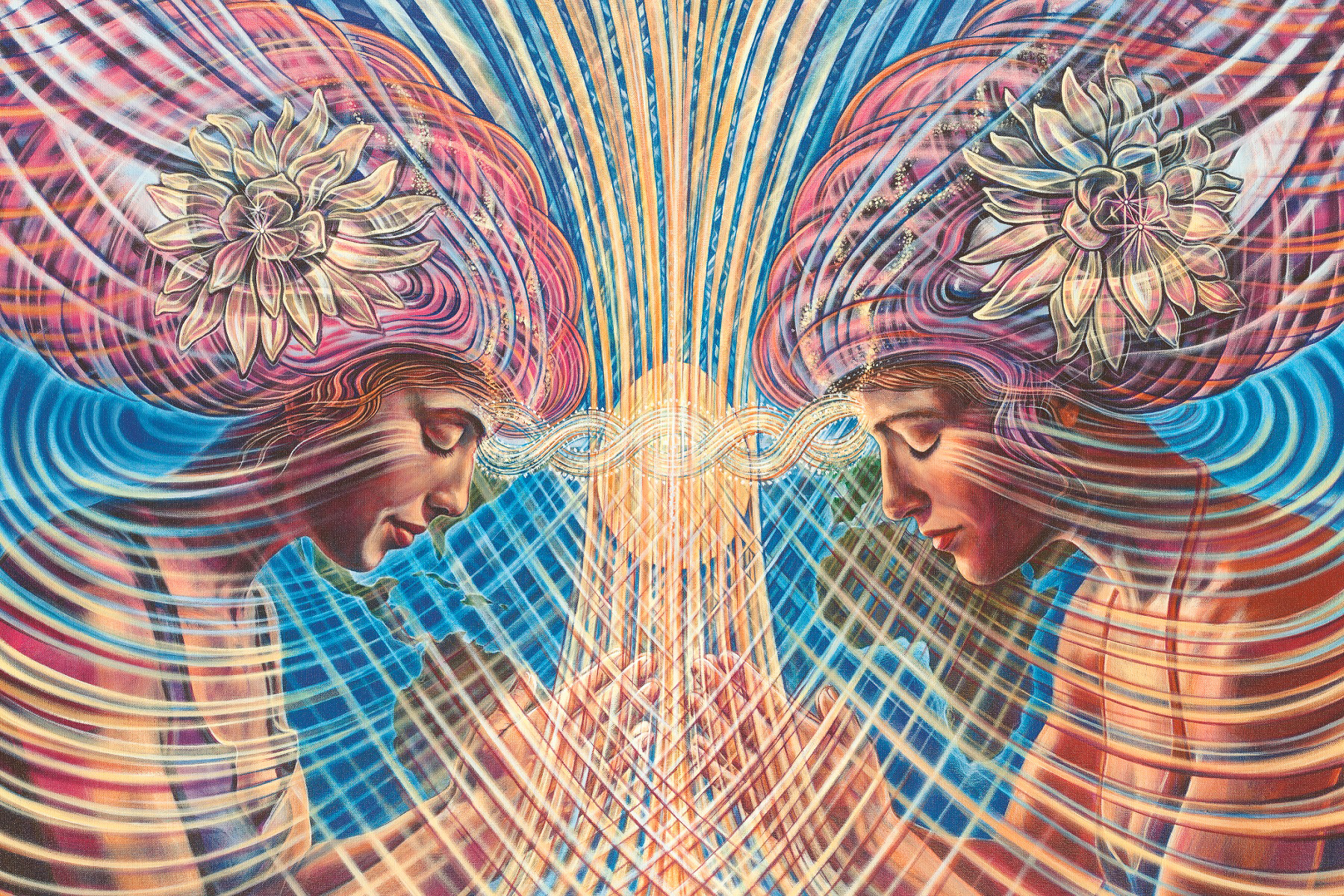
1. What is consciousness?
Answer
Consciousness is one of the most familiar things we experience and yet one of the hardest to explain. It is the simple fact that experience is happening at all: that we can see, hear, think, feel and know that we exist.
Science can examine the brain processes associated with conscious experience, but describing those physical processes does not automatically explain why there should be an inner experience accompanying them.
Meditation approaches the question from another direction. Instead of examining consciousness only from the outside, we can investigate it directly by observing what remains as thought, sensation and mental activity become quieter.
This raises a profound possibility: consciousness may not merely be something the brain produces, but something more fundamental within which our ordinary mental life occurs.
2. Is consciousness the same thing as the mind?
Answer
In ordinary conversation we often use the words mind and consciousness almost interchangeably, but they may describe quite different things.
The mind includes thoughts, memories, imagination, emotions, beliefs and the continuous mental commentary that accompanies everyday life. Consciousness is the awareness within which all of these experiences appear.
Meditation makes this distinction particularly clear. A thought can disappear while awareness remains. An emotion can pass while awareness remains. Even when the mind becomes remarkably still, there can still be a vivid sense of being conscious.
This suggests that the mind may be something occurring within consciousness rather than consciousness itself.
3. Where do our thoughts come from?
Answer
We normally assume that we deliberately create our thoughts, yet careful observation reveals something rather curious: most thoughts simply appear.
We can certainly direct thinking deliberately, such as when solving a mathematical problem or planning a journey. But much of ordinary thought arises spontaneously. Memories, ideas, worries and fragments of inner conversation seem to enter awareness without being consciously summoned.
Meditation makes this easier to observe because we become less involved in the content of thinking and more aware of the process itself.
This raises an intriguing question. If we are able to observe thoughts arriving and disappearing, then perhaps the consciousness observing them is not identical to the thoughts themselves.
4. Can consciousness exist without thought?
Answer
Ordinary waking life contains so much mental activity that it is easy to assume consciousness depends upon continuous thought.
Meditation suggests otherwise. As thought becomes quieter, awareness does not necessarily diminish. In some circumstances it can become clearer, more spacious and more vivid.
There may be periods in which very little thought is present, yet there is no sense of unconsciousness. Instead there can be an extraordinary simplicity in which awareness exists without the usual stream of internal commentary.
This is one of meditation’s most important discoveries because it suggests that consciousness may be more fundamental than the thinking mind.
5. Does the brain create consciousness?
Answer
There is no doubt that the brain and conscious experience are intimately connected. Changes to the brain can alter memory, perception, personality and our ability to think.
The deeper question, however, is whether this proves that the brain actually creates consciousness. Correlation does not by itself establish the direction of causation.
Another possibility is that the brain acts as an interface or instrument through which consciousness operates during physical life. In such a model, damage to the instrument would naturally affect the expression of consciousness without necessarily proving that consciousness originates there.
This remains an open philosophical and scientific question. Deep meditative experience provides an additional perspective because consciousness can sometimes appear far more extensive than ordinary brain-based identity would suggest.
6. Do we experience reality directly?
Answer
It feels as though we simply open our eyes and see the world exactly as it is. In reality, our experience is constructed from information gathered by the senses and interpreted by the nervous system and brain.
Colour, sound, taste and smell are particularly interesting examples. The external world contains electromagnetic radiation, pressure waves and molecules, but the vivid experiences of red, music, sweetness or perfume arise within consciousness.
What we normally call reality is therefore partly the external world and partly the way our perceptual system represents that world to us.
Meditation takes this investigation further by asking whether even the familiar division between an observer and an observed world may itself be part of the way consciousness ordinarily structures experience.
7. Why do we normally feel located inside the body?
Answer
Most people have a strong intuitive feeling that they are located somewhere inside the body, often somewhere behind the eyes or within the head.
This makes practical sense because our principal senses are organised around the body. Vision, hearing, touch and balance continually provide information from a particular physical viewpoint.
Yet the feeling of being a small observer positioned inside the head is itself an experience occurring within consciousness. When examined carefully during meditation, this apparent centre can become surprisingly difficult to locate.
In deeper states the sense of a fixed centre may weaken or disappear altogether, while awareness remains. This raises the possibility that consciousness is not actually situated within the body in quite the simple way we normally assume.
8. Is the sense of being a separate self an illusion?
Answer
The ordinary sense of self is extremely convincing. We experience ourselves as a separate individual with a body, personality, history and private inner world.
At one level this identity is entirely practical and necessary. It allows us to function, communicate and take responsibility for our lives.
Meditation, however, can reveal that the psychological sense of being a separate observer at the centre of experience is not as solid as it appears. Thoughts about ourselves arise and disappear just like other thoughts.
When those thoughts and habitual patterns become sufficiently quiet, awareness may remain without the same feeling of separation. The individual still functions, but the boundary between self and reality can seem far less absolute.
9. Could consciousness be a fundamental part of reality?
Answer
The conventional scientific approach usually begins with matter and attempts to explain how consciousness eventually emerges from complex physical systems such as brains.
But another possibility is that consciousness is not a late arrival in the universe at all. It might instead represent some fundamental aspect of reality, with biological organisms providing increasingly complex ways through which it can be expressed.
Ideas of this kind appear in philosophy as well as in many spiritual traditions, although no single explanation has been scientifically established.
Deep meditation gives the question particular significance because consciousness can sometimes be experienced not as a small private phenomenon inside an individual, but as something vast, pervasive and much more fundamental than ordinary personal awareness.
10. Can meditation reveal the true nature of reality?
Answer
Meditation cannot replace scientific investigation of the physical universe, but it can investigate something that external instruments cannot directly measure: the structure of conscious experience itself.
As thought becomes quieter, assumptions that normally remain unnoticed can begin to fall away. The distinction between observer and observed, the sense of being located within the body and even the familiar boundary between self and world may all be experienced differently.
At greater depths there may also be experiences of inner Light and Sound, profound stillness and expanded states of consciousness that challenge our ordinary understanding of reality.
Meditation therefore offers a form of direct exploration. Rather than merely asking what reality is from the outside, it asks whether consciousness itself can penetrate more deeply into the nature of existence.